Staging was built around a cost structure that assumes a fast sale: rent the furniture, schedule the installation, and hope the property sells before ongoing fees begin to outweigh the benefit. When a listing sits longer than expected, those costs can steadily eat into an agent's or brokerage's margin.
AI virtual staging rewrites that equation.
You pay to create the images, not for every additional day the property remains unsold. But fixed staging costs are only one part of the return. AI can also reduce production delays, make relaunching a listing more affordable, and allow agents to stage more rooms across more properties.
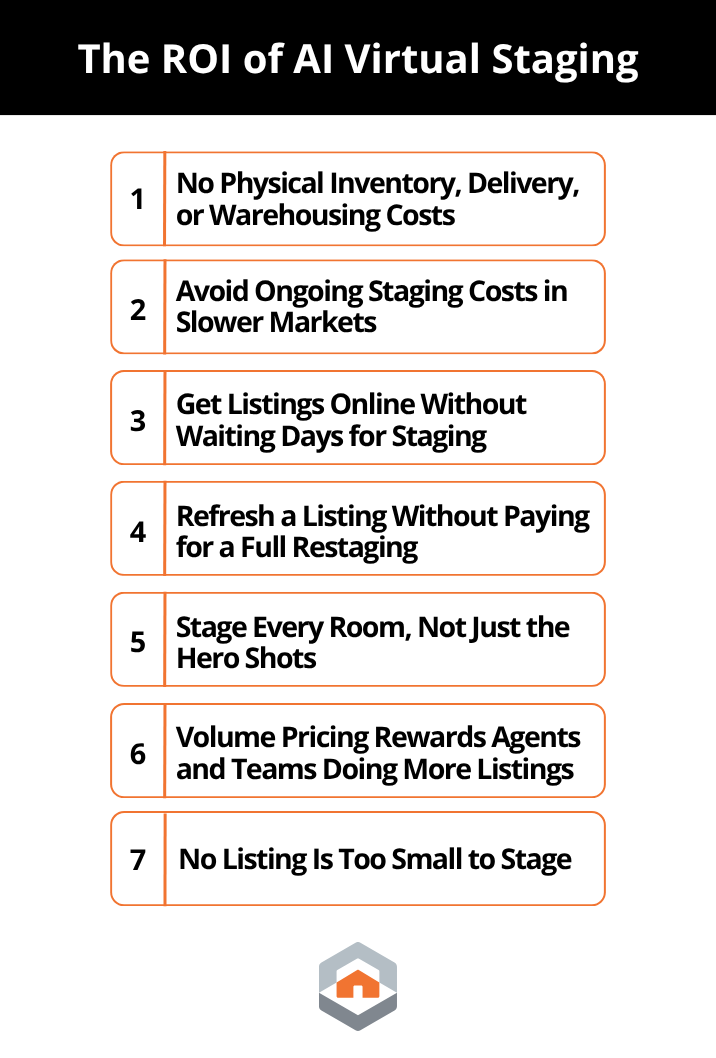
Here are seven ways those savings play out in practice, along with simple ways to measure the ROI across your own listings.
How AI Virtual Staging Saves Money Across the Life of a Listing
The savings start with the most obvious comparison: replacing physical furniture, delivery, and storage with digitally generated images. But the financial impact continues throughout the listing process, from the first photo to a potential relaunch.
1. No Physical Inventory, Delivery, or Warehousing Costs
Physical staging means moving furniture, decor, and accessories in and out of a property, often more than once if a listing needs to relaunch or extend. Every trip in and out carries the risk of scuffed hardwood floors, dented drywall, chipped trim, or a scratched doorframe from a couch that didn't quite clear the hallway. Repairing that damage before closing means bringing in a contractor, absorbing the cost, or negotiating it out of the final sale price.
AI virtual staging removes that risk completely.
There's no furniture to transport, no crew moving heavy items through a property, and no delivery truck parked outside during showings. Because nothing physical ever enters the home, there’s no staging-related damage to remediate and no invoice that shows up after the fact to erode the commission.
The ROI: cost avoidance here isn't a projection or a best-case estimate. It's guaranteed. A listing staged physically carries a non-zero chance of an unplanned repair bill; a listing staged with AI carries none.
2. Avoid Ongoing Staging Costs in Slower Markets
Physical and designer-led staging are typically priced as ongoing arrangements. Furniture rental contracts and storage fees renew for as long as the property stays on the market, so the total staging bill grows the longer a listing takes to sell.
That makes traditional staging more expensive on average when the market slows.
Across the U.S., the median time to sell reached 66 days in 2026, nine days longer than the 57-day median from the year before. In Hawaii, homes were averaging around 104 days on the market. Likewise, Metro Vancouver homes were averaging 100 days on the market at the start of 2026.
Whether a listing sells in two weeks or four months, with AI staging, the line item on the closing statement stays exactly the same.
The ROI: in a slow market, this is where AI staging protects margin the most directly. The cost is disconnected from the one variable, time on market, that a seller or agent can't fully control.
3. Get Listings Online Without Waiting Days for Staging
Slow markets aren't the only place staging speed affects ROI. In hot real estate markets, the pressure runs in the opposite direction. San Jose homes are currently selling in a median of just 12 days, the fastest pace of any major US market. In a window that tight, a listing that isn't staged and live within a day or two of being photographed is already behind.
Traditional staging, physical or designer-led, was never built for that pace. Scheduling a furniture delivery, briefing a designer, or waiting on a revision round can easily consume two or three days on its own. That is a time a 12-day market cannot spare. By the time a physically staged listing is photo-ready, a competing property may already be under contract.
AI virtual staging closes that gap. Images can be generated the same day a property is shot, so listings go live while buyer interest and inventory are still working in the seller's favor.
The ROI: in a hot market, the return isn't measured in dollars saved on staging. It's measured in whether a listing captures its window at all. A day or two of lost turnaround time in a 12-day market is a meaningfully larger share of the sales cycle than the same delay would be in a 66-day one.
4. Refresh a Listing Without Paying for a Full Restaging
Sometimes, a listing just needs to be refreshed. A price adjustment, a seasonal relaunch, or buyer feedback pointing to the wrong style can all mean a property needs new photos partway through its time on sale.
With physical or designer-led staging, a refresh means paying close to full price again. Furniture has to be rearranged or swapped, or a designer has to revisit the brief and produce new renders from scratch. The cost structure doesn't recognize that most of the work, the layout, the room, the bones of the listing, hasn't changed.
AI virtual staging makes those changes far less expensive. Some of the best virtual staging solutions let agents test different furniture styles, update individual rooms, or generate a fresh set of images for the cost of a few additional credits.
The ROI: this is where AI staging protects margin on the listings that need the most help. A property that's already sitting longer than expected is exactly the property where a second staging bill hurts the most, and exactly where AI keeps that cost from compounding.
5. Stage Every Room, Not Just the Hero Shots
When staging is priced by the project, room, or manually edited image, agents often have to prioritize. The living room, kitchen, and primary bedroom get staged, while secondary bedrooms, offices, basements, and awkward spaces are left empty.
That may keep the project within budget, but it can create an uneven listing experience. An empty room next to a fully staged one makes it harder for a buyer to picture the space, and it can make the whole property feel smaller or less cared for than it is.
Because AI virtual staging is priced per image rather than per project, there's no budget-driven reason to skip rooms. A five-bedroom listing costs the same proportionally whether two rooms are staged or all five, as long as every staged image is disclosed correctly.
The ROI: a fully staged listing gives buyers a more complete and consistent view of the property. Achieving that level of coverage can be difficult to justify financially with traditional staging, but costs relatively little with AI.
6. Volume Pricing Rewards Agents and Teams Doing More Listings
Traditional staging pricing doesn't reward volume in any meaningful way. A designer or physical staging company generally charges close to the same rate per room or per project, whether an agent stages one listing a month or ten. There's little financial incentive built in for agents or brokerages doing high volume.
AI virtual staging pricing works differently. Credit-based plans lower the cost per image as monthly usage increases, so an agent or team staging multiple listings a month pays a lower rate per photo than someone staging occasionally. The more a brokerage relies on AI staging across its listings, the more the per-image cost compresses.
On Virtual Staging Art's annual plans, photo credits start at $0.55 on the entry-level plan. Agents staging 10-15 listings a month bring that down to roughly $0.41 per photo credit, and brokerages producing 20-30 listings a month pay closer to $0.37. The cost curve bends in the agent's favor as volume increases, rather than staying flat the way traditional staging pricing does.
The ROI: for high-volume agents and teams, this is where the savings compound. The per-image cost keeps dropping as the number of listings grows, which means the ROI of AI staging actually improves the busier a brokerage gets.
7. No Listing Is Too Small to Stage
On a lower-priced listing, or one where the seller is watching every dollar of commission, the cost of staging can outweigh the perceived benefit, especially if the listing is vacant and staging means furnishing an entire property from scratch. In those cases, staging often gets skipped entirely rather than partially budgeted.
That’s a cost in itself. An unstaged listing next to staged comparables in the same price range tends to make a weaker first impression, and vacant rooms are harder for buyers to picture living in. NAR’s report said 29% of agents reported the dollar value for their listings increasing by 1-10%.
The properties that could benefit most from staging, lower-budget or vacant listings with less built-in appeal, are often the ones that go without it.
The ROI: this is upside captured across an entire portfolio. Every property gets the same shot at a strong first impression, regardless of price point or condition, which protects against the properties most likely to sit and quietly erode margin, the way point 2 already covered.
The Real ROI of AI Virtual Staging
The clearest return from AI virtual staging is the money it helps agents avoid spending: no furniture rental, no delivery fees, no storage, no contract extensions, and no expensive restaging process when a listing needs a refresh.
But the larger benefit is flexibility.
AI makes it affordable to stage more rooms, prepare listings faster, refresh underperforming properties, and maintain a consistent presentation standard across an entire portfolio. Instead of deciding whether a listing can justify staging, agents can focus on which images will help buyers understand the space.
Virtual Staging Art lets you generate staged listing images in seconds, test different styles, and scale production using a credit-based pricing model.
Try Virtual Staging Art for free. Every new account gets 10 free renders, no credit card required. Stage a real listing. See the difference before committing to a plan.