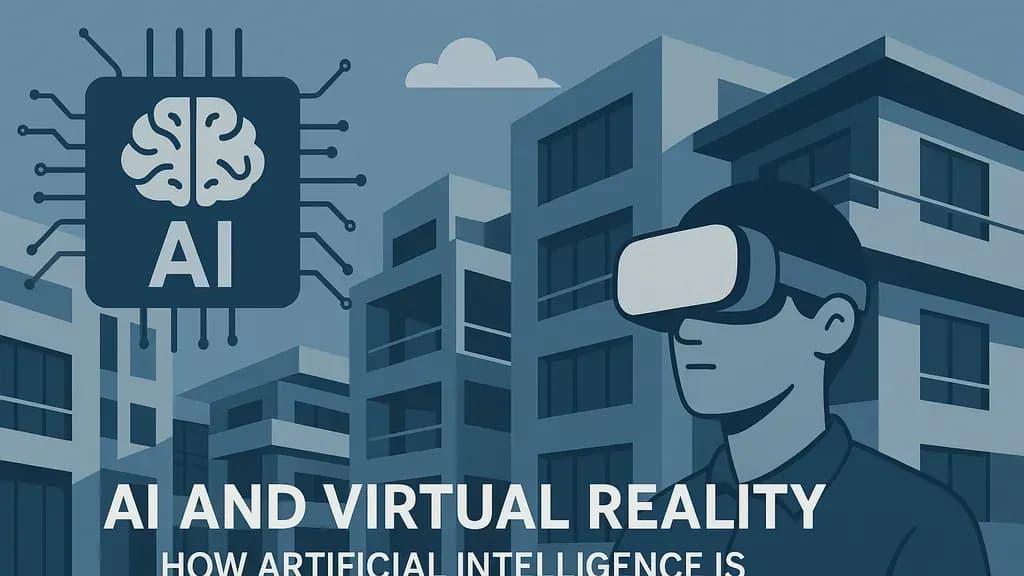
Artificial intelligence and virtual reality are no longer separate technologies operating in isolation. In 2026, their convergence is reshaping how we work, learn, and interact with digital environments. From AI-powered virtual training simulations to intelligent avatars that adapt to user behavior, the integration of these technologies is creating experiences that were impossible just a few years ago.
This article explores how AI and virtual reality work together, the practical applications transforming industries today, and what this convergence means for the future of immersive technology.
What Are AI and Virtual Reality?
Defining Virtual Reality
Virtual reality creates computer-generated environments that users can explore and interact with through headsets and controllers. Modern VR ranges from fully immersive experiences that block out the physical world to mixed reality (MR) that blends digital content with real surroundings.
The VR hardware landscape has matured significantly. Standalone headsets like Meta Quest 3 and Pico 5 no longer require external PCs, making VR more accessible. The global VR market was valued at approximately $53.95 billion in 2026, with projections reaching $187.28 billion by 2032.
Defining Artificial Intelligence
Artificial intelligence refers to systems that can learn, reason, and make decisions autonomously. In the context of VR, AI encompasses several key technologies:
- Machine learning: Algorithms that improve through experience and data analysis
- Computer vision: Systems that interpret visual information from the environment
- Natural language processing: Technology that understands and generates human language
- Generative AI: Tools that create new content, from 3D assets to entire virtual environments
These AI capabilities aren't just theoretical enhancements. They're actively changing how VR content is created, how users interact with virtual worlds, and how immersive experiences adapt to individual needs.
The AI and VR Market in 2026
The convergence of AI and VR represents one of the fastest-growing segments in tech. In 2023, the global AI in VR and AR market was valued at $39.2 billion, and growth has accelerated as AI capabilities have expanded.
The Virtual, Augmented And Mixed Reality (VR/AR) Market worth USD 26.9 billion in 2026 is growing at a CAGR of 31.67% to reach USD 106.42 billion by 2031. This explosive growth reflects several converging factors:
- More affordable and capable hardware
- AI-driven content creation tools that reduce development costs
- Expanding enterprise adoption beyond gaming
- 5G infrastructure enabling cloud-rendered VR experiences
Key adoption metrics paint a clear picture of mainstream momentum. About 171 million people worldwide currently use VR in some form, while 40% of healthcare providers are using VR for patient treatment and staff training. In education, 30% of universities worldwide now offer VR-based courses as of 2024.
How AI Enhances Virtual Reality Experiences
Intelligent Content Generation
One of AI's most transformative impacts on VR is accelerating content creation. Traditional 3D modeling requires specialized skills and countless hours. Through machine learning, computer vision, and natural language processing, AI enhances spatial awareness, interaction fidelity, and real-time content generation. Generative AI automates 3D asset creation and rendering, while adaptive algorithms personalize experiences based on user data.
According to industry analysis, AI is being used to generate procedural environments, create intelligent non-player characters, and even design entire worlds autonomously. This capability is particularly valuable for smaller development teams that previously couldn't afford the resources needed for high-quality VR content.
Adaptive and Personalized Experiences
AI doesn't just create content; it makes VR experiences smarter and more responsive. Virtual environments can now analyze user behavior and adjust in real-time:
- Training simulations that adapt difficulty based on learner performance
- Virtual retail environments that highlight products matching user preferences
- Therapeutic VR that modifies scenarios based on patient response and biometric data
This trend is allowing for more dynamic and personalized VR experiences, where virtual worlds can evolve based on user behavior.
Intelligent Virtual Characters
AI-powered avatars and non-player characters (NPCs) have evolved beyond scripted responses. AI avatars and Metahumans can conduct natural conversations, acting as trainers, guides, or brand representatives. These intelligent characters understand context, remember previous interactions, and respond naturally to voice commands and gestures.
In educational VR, AI instructors can answer questions, provide feedback, and adjust teaching methods based on student comprehension. In enterprise training, virtual colleagues can simulate realistic workplace scenarios with unpredictable, human-like behavior.
Performance Optimization
AI also works behind the scenes to improve VR performance. Machine learning algorithms optimize rendering, predict user movement to reduce latency, and manage computational resources to prevent motion sickness. These technical improvements make VR more comfortable and accessible, especially on standalone headsets with limited processing power.
Real-World Applications of AI and VR
Healthcare and Medical Training
The healthcare sector has emerged as one of the strongest use cases for AI-powered VR. Medical students use VR simulations with AI-controlled patient avatars that exhibit realistic symptoms and respond to treatment decisions. The healthcare AR market has grown from approximately $610 million in 2018 to projected levels exceeding $4.2 billion by 2026. Current adoption shows 40% of healthcare providers using VR for patient treatment and staff training.
Beyond training, AI and VR support patient care through:
- Pain management and anxiety reduction during procedures
- Physical therapy with AI-guided exercises that adapt to patient capability
- Cognitive rehabilitation for stroke and brain injury patients
- Exposure therapy for phobias and PTSD with AI-controlled scenario progression
Corporate Training and Workforce Development
Companies are deploying AI-enhanced VR for employee training at unprecedented scale. Virtual simulations allow workers to practice dangerous procedures, complex equipment operation, and customer service scenarios in safe, repeatable environments.
Squint offers easy creation of practical demos for manufacturing workers, and Loft Dynamics' VR simulators expand training options for helicopter and airplane pilots. The Federal Aviation Administration has approved VR pilot training systems, validating their effectiveness for high-stakes professional preparation.
AI adds critical value by analyzing trainee performance, identifying skill gaps, and automatically adjusting difficulty. This personalized approach accelerates learning while ensuring competency before real-world application.
Gaming and Entertainment
While enterprise applications dominate growth, gaming remains a core VR use case. The gaming industry remains one of the primary drivers of VR adoption, with an estimated 70% of VR users engaging with gaming content regularly.
AI transforms gaming experiences through:
- NPCs with adaptive strategies that learn from player behavior
- Procedurally generated game worlds that create endless content
- Voice-controlled interactions with in-game characters
- Dynamic difficulty adjustment for optimal challenge levels
Education and Remote Learning
Educational institutions have embraced AI and VR as teaching tools extend beyond traditional classrooms. Students can explore historical sites, conduct virtual chemistry experiments, or practice surgical techniques—all enhanced by AI guidance.
In one educational experiment in Taiwan, Japanese students joined with Taiwanese students in a metaverse environment to learn together. Thanks to VR/AR, they were able to learn together in real time despite being in different physical places. Also, thanks to AI-powered translation, they were able to communicate with each other in real time despite speaking different languages.
AI and VR in Real Estate
The real estate industry represents a particularly strong application of AI and VR convergence. Traditional property viewings are time-consuming and geographically limited. Virtual tours solve this problem, while AI makes those tours significantly more useful.
Virtual Property Tours and Staging
Statistics show that 77% of prospective buyers prefer using virtual reality to view properties remotely. AI enhances these experiences by enabling intelligent virtual staging—populating empty rooms with furniture and décor that matches buyer preferences.
AI Virtual staging leverages advanced algorithms and rendering techniques to populate empty rooms with visually appealing presentations. This technology has become essential for real estate marketing, particularly as traditional physical staging can cost $2,000-5,000+ per property.
For realtors and property sellers looking to leverage this technology, [AI-powered virtual staging tools](https://www.virtualstaging.art) can generate professionally staged photos from empty room images starting from 50c per photo—a fraction of traditional staging costs.
Personalized Property Recommendations
AI algorithms analyze buyer behavior during VR property tours—which rooms they spend time in, which features they examine closely, what questions they ask. This data powers intelligent property recommendations, matching buyers with listings that align with their demonstrated preferences rather than just stated criteria.
62% of U.S. buyers said a virtual tour is the single most influential factor in their decision-making, and 71% said they would be willing to make an offer based solely on a 3D tour.
Remote and International Buyers
AI-enhanced VR tours have opened real estate markets to buyers who can't physically visit properties. International investors, relocating families, and remote homebuyers can conduct thorough property evaluations through immersive virtual walkthroughs with AI assistants answering questions in real-time.
Technical Challenges and Ethical Considerations
Computational Requirements and Latency
Despite significant progress, AI-powered VR still faces technical hurdles. Real-time AI processing demands substantial computational power. Latency—the delay between user action and system response—remains a critical challenge. Even milliseconds of lag can break immersion or cause motion sickness.
Cloud-based solutions show promise but depend on robust internet connectivity. 5G networks are helping, but coverage remains inconsistent. Balancing AI capabilities with performance constraints requires careful optimization.
Data Privacy and Security
AI-enhanced VR systems collect extensive user data: eye movements, physical gestures, voice recordings, biometric responses, and behavioral patterns. This information enables personalization but raises serious privacy concerns.
Research from academic institutions highlights cybersecurity challenges as VR systems handle sensitive personal and financial information. Clear policies governing data collection, storage, and use are essential, particularly as regulations like GDPR impose strict requirements.
Algorithmic Bias and Fairness
AI systems can perpetuate or amplify biases present in their training data. In VR applications, this could manifest as:
- Virtual avatars defaulting to certain demographics
- Training simulations that favor specific learning styles
- Recommendation systems that reinforce existing preferences rather than expanding options
Developers must actively work to identify and mitigate bias throughout the design process.
Accessibility and Digital Divide
While VR hardware costs have decreased, AI-powered VR experiences often require premium devices and high-speed internet. This creates accessibility barriers that could exclude lower-income users, rural communities, and developing regions from benefits in education, healthcare, and workforce development.
The Future of AI and VR Integration
Hyper-Realistic Simulations
The next generation of AI and VR will blur the line between virtual and physical reality. Advances in computer vision, photogrammetry, and neural rendering will create photorealistic environments that respond intelligently to user presence.
Photorealistic VR environments will become the standard in enterprise training, particularly for high-stakes scenarios where realism directly impacts learning outcomes.
Multimodal AI Integration
Future systems will seamlessly combine multiple AI capabilities: voice recognition, gesture tracking, emotion detection, and predictive analytics. AI-driven advances such as real-time speech recognition, human gesture tracking, and natural language processing will significantly improve interaction with virtual environments and unlock new ways to use the technology.
Cross-Reality Experiences
The boundaries between virtual reality, augmented reality, and mixed reality will become more fluid. AI will manage transitions between these modes, adjusting content and interaction methods based on context and user needs. You might start a task in AR, switch to full VR for detailed work, then return to MR for collaboration with physical colleagues.
Democratized Content Creation
AI will continue making VR content creation accessible to non-specialists. Natural language interfaces will allow users to describe desired environments, characters, or interactions in plain English, with AI generating the necessary 3D assets and programming.
The VR content creation services market, which relies heavily on AI-generated assets and 5G-enabled delivery, will be valued at USD 6.55 billion in 2026 and is projected to reach USD 41.47 billion by 2031. Platforms such as Unity Muse and Epic Games' Unreal Engine 5.4 now auto-generate 3D meshes and dialogue trees, reducing manual modelling hours by 60%.
Industry-Specific Evolution
Different sectors will see specialized AI and VR applications emerge:
- Manufacturing: Digital twins powered by AI that simulate entire production lines in VR
- Retail: Virtual showrooms with AI sales assistants that understand product knowledge and customer preferences
- Healthcare: Surgical planning systems that combine patient-specific medical imaging with AI-guided procedure rehearsal
- Architecture: Collaborative design environments where AI suggests structural improvements in real-time
For real estate specifically, expect AI to enable instant property modifications during virtual tours—changing wall colors, flooring, or layouts on demand based on buyer feedback. This level of customization will transform how properties are marketed and sold.
Conclusion
The convergence of AI and virtual reality represents more than incremental technological progress. It's a fundamental shift in how humans interact with digital information and virtual environments. AI makes VR smarter, more accessible, and more useful across industries from healthcare to real estate.
The market data confirms this trajectory: The Virtual Augmented And Mixed Reality Market was valued at USD 20.43 billion in 2025 and estimated to grow from USD 26.9 billion in 2026 to reach USD 106.42 billion by 2031, at a CAGR of 31.67% during the forecast period.
For businesses and professionals, the question isn't whether to explore AI-enhanced VR, but how to implement it strategically. The technologies are mature enough for practical deployment while still evolving rapidly. Early adopters in training, customer experience, and visualization are seeing measurable returns on investment.
As these technologies continue advancing, the experiences they enable will become increasingly indistinguishable from physical reality—enhanced by intelligent systems that understand context, anticipate needs, and adapt seamlessly to human behavior. The future of AI and VR isn't about escaping reality; it's about expanding what's possible within it.