Why Your Lens Choice Matters More Than Your Camera {#why-your-lens-choice-matters}
I've seen agents spend thousands on the latest camera body, then wonder why their listing photos still look cramped and uninviting. The truth? Your lens matters more than your camera when photographing properties.
A wide-angle lens transforms a 200-square-foot bedroom into an accurate representation of the space buyers can actually envision themselves in. According to the National Association of Realtors' 2023 Profile of Home Staging, 81% of buyers' agents say staging makes it easier for buyers to visualize the property—and the same principle applies to how you photograph that space.
The wrong lens creates distortion that makes rooms look smaller than they are, introduces unflattering perspective issues, or fails to capture enough of the space in one frame. The right lens does the opposite: it shows accurate proportions, maintains straight vertical lines, and captures entire rooms without requiring you to back through a wall.
What is a Real Estate Photography Lens? {#what-is-real-estate-lens}
A real estate photography lens is typically a wide-angle lens designed to capture more of a room than the human eye sees in a single glance. Most real estate lenses have a focal length between 14mm and 24mm on full-frame cameras (or 10mm-16mm on crop-sensor cameras).
Unlike portrait lenses that isolate subjects with a narrow field of view, real estate lenses prioritize spatial context. They answer the buyer's fundamental question: "How big is this room, and what's in it?"
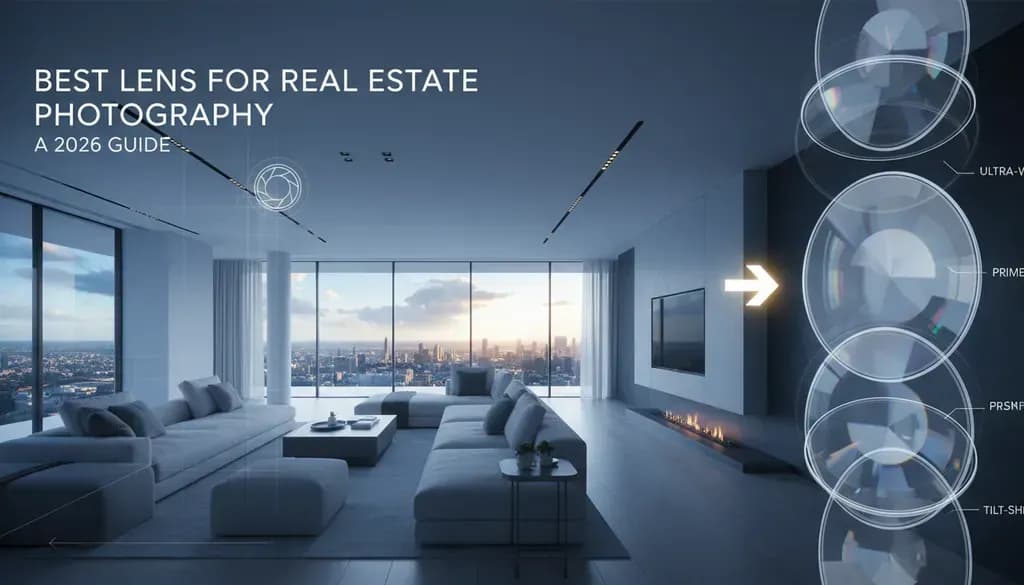
The 3 Main Lens Types for Property Photography {#lens-types}
Wide-Angle Lenses (14-35mm)
Wide-angle lenses are the industry standard for real estate photography. A 16-24mm focal length captures full rooms from corner positions without requiring extensive backtracking.
Best for: Interior rooms, tight spaces, showing entire kitchens or bathrooms, emphasizing spaciousness
Watch out for: Edge distortion (straight lines can bow at frame edges), exaggerated depth (objects appear farther apart than reality)
I recommend starting with a 16-35mm zoom if you're shooting various property sizes. The focal length flexibility helps you adapt to studio apartments and sprawling estates alike.
Tilt-Shift Lenses (17-24mm)
Tilt-shift lenses allow you to correct perspective distortion, keeping vertical lines perfectly straight even when shooting upward or at an angle. This is the secret weapon of high-end architectural photographers.
Best for: Tall buildings, staircases, rooms with high ceilings, luxury property marketing
Watch out for: Price ($1,500-2,500), manual focus only, steeper learning curve
These lenses are overkill for standard residential listings but make a visible difference in commercial real estate and luxury home photography.
Standard Lenses (35-50mm)
Standard lenses provide a natural perspective similar to human vision. While not wide enough for most interior work, they excel at detail shots.
Best for: Architectural details, fixture close-ups, outdoor property features, neighborhood context shots
Watch out for: Too narrow for most full-room shots in average homes
I keep a 50mm in my bag for detail shots of custom tilework, built-in shelving, or garden features after I've captured the wide establishing shots.
How to Choose the Right Lens: 5 Key Factors {#choosing-factors}
1. Camera Compatibility and Sensor Size
Lens focal lengths perform differently on crop-sensor versus full-frame cameras. A 16mm lens on a crop-sensor Canon (1.6x crop factor) behaves like a 25.6mm lens—noticeably narrower.
If you're shooting on a crop sensor (most entry-level DSLRs and mirrorless cameras), look for lenses in the 10-16mm range to achieve true wide-angle coverage. Full-frame shooters should target 16-24mm.
2. Focal Length for Your Property Types
The properties you shoot most often should dictate your focal length choice:
- Apartments and condos: 14-16mm (maximum width for small rooms)
- Standard single-family homes: 16-24mm (the sweet spot for most interiors)
- Luxury estates: 17mm tilt-shift or 16-35mm zoom (flexibility for varied room sizes)
- Commercial spaces: 24mm tilt-shift (perspective control for tall spaces)
3. Maximum Aperture and Low-Light Performance
Real estate photography often happens in dim interiors. A wider maximum aperture (f/2.8 vs. f/4) lets in more light, enabling faster shutter speeds and lower ISO settings.
That said, you'll typically shoot at f/8-f/11 for maximum depth of field anyway. An f/4 lens costs significantly less than f/2.8 and performs nearly identically in practice when mounted on a tripod (which you should be using).
4. Image Quality: Sharpness and Distortion
All wide-angle lenses introduce some barrel distortion (straight lines bowing outward). The question is how much and how correctable it is.
Modern lenses often include distortion correction profiles that work automatically in Lightroom and Photoshop. According to DXOMark's lens testing data, higher-end lenses show 1-2% distortion versus 3-5% in budget options—a meaningful difference when photographing rooms with lots of straight lines.
Corner sharpness matters too. Buyers notice soft, blurry edges in listing photos. Read lens reviews specifically mentioning corner performance before purchasing.
5. Price: Where to Invest and Where to Save
Real estate photography lenses range from $300 to $2,500. Here's where that money goes:
- $300-600: Third-party brands (Tamron, Sigma, Tokina) with good sharpness but more distortion
- $800-1,200: First-party mid-tier options (Canon RF 16mm f/2.8, Nikon Z 14-30mm f/4) balancing quality and cost
- $1,500-2,500: Professional-grade lenses (Canon 16-35mm f/2.8L III, Nikon 14-24mm f/2.8G) and tilt-shift options
If you're shooting 2-3 listings per month, a $600 lens provides excellent ROI. Full-time real estate photographers should invest in the $1,200+ range for durability and image quality that justifies premium pricing.
Top Lens Recommendations by Camera System {#recommended-lenses}
For Canon Full-Frame (RF Mount)
Canon RF 16mm f/2.8 STM ($299): The budget champion. Incredibly sharp for the price, though you lose zoom flexibility with the fixed focal length.
Canon RF 15-35mm f/2.8L IS USM ($2,299): Professional workhorse with excellent corner sharpness and built-in image stabilization.
For Canon Full-Frame (EF Mount)
Canon EF 16-35mm f/4L IS USM ($1,099): My personal recommendation for most real estate photographers. Sharp across the frame, manageable weight, and the f/4 aperture rarely limits you on a tripod.
Tokina 16-28mm f/2.8 AT-X Pro FX ($599): Best budget option with surprisingly good image quality.
For Nikon Full-Frame (Z Mount)
Nikon Z 14-30mm f/4 S ($1,297): Compact, sharp, and takes standard filters (unlike the older 14-24mm f/2.8).
Nikon Z 14-24mm f/2.8 S ($2,397): For professionals who need the extra stop of light and maximum sharpness.
For Nikon Full-Frame (F Mount)
Nikon AF-S 16-35mm f/4G ED VR ($1,097): Well-balanced option with vibration reduction.
Nikon AF-S 14-24mm f/2.8G ED ($1,897): The legendary ultra-wide with exceptional corner-to-corner sharpness.
For Sony Full-Frame (E Mount)
Sony FE 16-35mm f/4 ZA OSS ($1,348): Lightweight with excellent correction profiles in post-processing.
Tamron 17-28mm f/2.8 Di III RXD ($899): Outstanding value with near-professional image quality at half the price.
For Crop-Sensor Cameras
Sigma 10-20mm f/3.5 EX DC HSM ($449): Works across Canon, Nikon, and Sony crop sensors with solid performance.
Tokina 11-16mm f/2.8 AT-X Pro DX II ($479): Popular among real estate photographers for its sharpness and build quality.
How Virtual Staging Complements Good Photography
Even with the best lens, empty rooms can feel cold and uninviting in photos. This is where AI-powered virtual staging tools bridge the gap between vacant properties and buyer imagination.
After capturing sharp, well-composed wide-angle shots, virtual staging adds furniture, decor, and warmth to your images in minutes. Services like VirtualStaging.art start at $1 per render—a fraction of the $2,000-5,000 cost of physical staging—while giving you the flexibility to show multiple design styles from the same base photograph.
The combination works best when your original photography is already strong: correct perspective, good lighting, and proper focal length choice. Virtual staging enhances great photos; it doesn't rescue poor ones.
Lens Care and Maintenance {#lens-care}
Cleaning Your Lens Properly
Dust and fingerprints degrade image quality faster than lens age. Here's my cleaning routine:
- Use a rocket blower (not compressed air) to remove loose dust before touching the glass
- Apply 1-2 drops of lens cleaning fluid to a microfiber cloth, never directly to the lens
- Wipe in gentle circular motions from center to edge
- Keep lens caps on both ends when not actively shooting
Clean your lens before every shoot, not after you notice spots in your photos.
Storage That Prevents Damage
Store lenses in a padded case or camera bag with silica gel packets to control humidity. Fungus growth inside lenses is irreversible and thrives in humid environments above 60% relative humidity.
If you shoot in coastal or humid climates, consider a dry cabinet ($150-300) to protect your gear investment.
Protective Filters: Yes or No?
This divides photographers. I use UV or clear protective filters ($30-80) on the front element because replacing a $50 filter beats repairing a $1,200 lens. Critics argue filters reduce image quality.
The compromise: use high-quality multicoated filters (B+W, Hoya HD) that introduce minimal quality loss, or skip filters but use lens hoods religiously to protect against bumps and impacts.
Final Thoughts
Choosing the best lens for real estate photography comes down to matching focal length to your typical property size, investing proportionally to your shooting volume, and understanding that technique matters as much as gear.
A $600 wide-angle lens on a tripod with proper composition will outperform a $2,500 lens used handheld in poor lighting. Master the fundamentals with whatever lens you choose, and upgrade when your skills and business volume justify the investment.
Start with a versatile 16-35mm zoom (or 10-16mm for crop sensors), learn its distortion characteristics, and you'll have the foundation for professional property photography that helps listings sell faster.